In The Heart of the Drunkard

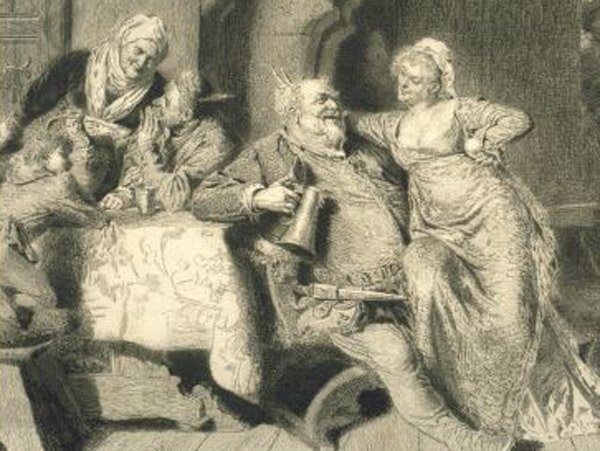
Falstaff

And away he went, to drink the value of his cross …

I have been listening to Fyodor Dostoevski’s The Idiot on the iPhone, from Audible.com. It’s incredible. I just know I’ll have to read it as soon as I’m done with the audio.

[I do irk myself somewhat on having become such a fan of audiobooks, as well as eBooks. I’d considered myself a purist in this regard, but have now roughly — in two senses of the word — embraced both electronic … I will call them enhancements. But it’s not about one way or the author — or one way or the other, for that matter. It’s simply about getting good words out there, so they can do their metaphysical magic.]

The words in this case are those quoted in italics in the first line, above, and the story that follows. Prince Myshkin is telling Rogozhin a story of how a beggar pawning a tin cross to get money for getting more drunk lied to him, the prince, and told him it was silver. Lev Nikolaevich notes the drunk smiled at the thought he had cheated this gentleman out of a very small amount of money.

So we have a man drunk, who is begging, lying, selling the symbol of his salvation, and giggling inside about cheating Myshkin. And then of course he (the drunk) goes off to buy more booze. And the whole time — during the events of the tale and the recounting of it to the evil and lost Rogozhin — he (the prince) speaks no syllable against the man supposedly running a very short con on him. The story closes with this:

I’ll wait awhile before I condemn this Judas. Only God knows what may be hidden in the hearts of drunkards.

And that’s why the prince is also The Idiot, that is to say the best and kindest character in the entire book.

And that’s why I say The Idiot is incredible, and I can’t say all of why, let alone understand the reasons.

And that’s why, of course, among other more prosaic reasons, I shall never be Fyodor Dostoevski.

Recent

Coyotes and Christians

I am not saying Christians are like coyotes. [For that, some could cut caustically to coyotes are like Christians — tricksters, roaming in the dark, feeding on the dead … ] Simply noticed — somewhat in passing, as it’s said, having attained, apparently … achieved? … some kind of state where nearly anything I hear,

Read More »

And Did Dostoevsky Say ‘Beauty Will Save’

Short answer: he did not. Neither did Prince Myshkin, that we know of. Likely both believed it. Beauty — in the person of Christ — will do so. And clearly D wrote of M in The Idiot to explore art and beauty and ugliness and salvation. But did he say it, and did he believe that

Read More »

What I Recalled Watching Netflix

[Television is educational.]   One Saying the same stuff over and over looks like you have different things to say. Two If you’re ever in a below-average film or streaming series, and you beat the tar out of a guy, in a house, and you gaze down in both some shock as also a certain

Read More »

Seeking the King

A line everywhere misattributed to Chesterton reads thus: The young man who rings the bell at the brothel is unconsciously looking for God. This line is not from the great [several senses of the word] man who recently celebrated his 150th birthday, but the mid-century most unmodern novelist Bruce Marshall. The words — which do

Read More »

Random

Like A Rolling Stone

A totally unscientific survey — texted my brother-in-law on the other coast — shows [my] fears of the death of the ice cream cone have been at least mildly exaggerated … tho looking, literally, a little topsy-turvy. A’course, I’d not heard anything specific; the reports were only in my head because about nothing from this

Read More »

I See That Hand

We imagine Thomas even doubted himself. When the other disciples said Christ had risen, this earnest empiricist first said, “unless I see” … then he realized it wasn’t enough. So he demanded to “thrust my hands into His side.” For Thomas, seeing wasn’t believing. But touch … that he had hopes for. * Seeing isn’t

Read More »

Duo

… More then says because he’s in prison and only has a coal with which to write he can’t respond fully to the view that one ought harm an evil man lest he cause even greater harm to such as are innocent and good. But He counsels us that even if it be our formal office to punish an evil

Read More »

Related

Can We Tawk?

Comedienne Joan Rivers’ catchphrase was, ‘Can we talk?’ with all that that entails — its rhetorical nature, the Jewish thing, an implication that at least one of the parties will be better off for having done so … Like God. T’other day a priest spoke of ontological remembrance, the immediate and ongoing memory of past-present-future

Read More »

Giant in the Land

Dallas Willard revised his affairs yesterday, moving to the headquarters of the Kingdom of the Heavens to live slightly nearer to God, whom he spoke of, served, embodied. The life he continues to live today. Unceasingly infused, this life was and is. For these ideas and Our Lord were everywhere in what Dr. Willard said

Read More »

Dirty Rotten Scoundrel

Some of my best friends have a problem with the dirty poor. These are the folks below the dirt-poor — which describes a financial level not the person himself. These are the dirt-encrusted, unemployed, possibly begging (relying on strangers, kindness, and a fair economy as much as the rest of us, anyway), frequently transient (the weather

Read More »