You’re Doing It Wrong

A friend once recounted how a mutual acquaintance of ours had told her God spoke to him, which he meant both literally and verbally.

It’s enough on one point to note the gent didn’t say God spoke with him — which wd seem to be preferred, all things taken together — but that isn’t what I’ll note here. What I replied then and repeat now is that perhaps this occurred because this fellow needed a good talking-to. That is, it wasn’t a sign of excess spirituality (is there such a thing?) as of deficient. I don’t think we need to assert defective, but that may’ve been so as well.

Reminded me at the time of the cartoon — a New Yorker-type, if not the thing itself — wherein a mom unloads piles of work papers from her briefcase while her daughter, looking on, observes, ‘Maybe you need to be in a slower class?’

+

A bug of mine I’ve come to see as feature is an ability oft if not always, commonly if not completely to flip the ol’ spyglass 180° and look through its t’other end. Chesterton a’course made a quarter or so of his career on such chiastic reversalism; I’m a piker by comparison but hope to make it to the Bigs one day.

Thus when a couple who’d been to Spain and that famous unfinished church and noted as how it’s all of a series of curves — no corners … summat like that — and followed that with the observation, there are no right angles in nature, it did occur to me to note, ‘Right — that’s our job as humans.’ Much as I enjoy curves, there are reasons right angles exist and it’s not just to torment 10th graders with shapes and formulae.

And when during a group discussion of personal agency a friend blithely lobbed the Kristofferson at us, it being just another word for nothing left to lose, well, oughtn’t one ask, ‘Izzat so?’

+

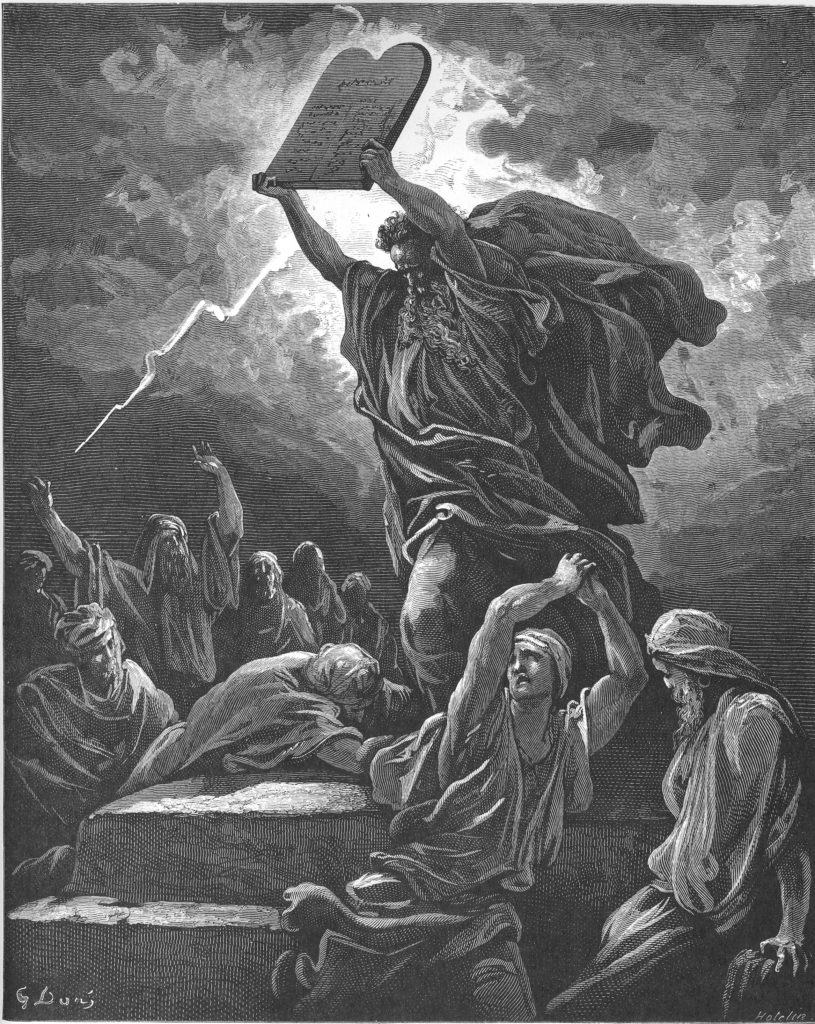
Same sort of error’s made all the time with rules and regs and laws and limits. We’ve come to think a ‘rule of law’ is some kind of heightened existence when it’s rather one of the lower types possible. If a rule is needed it’s not because we know what to do and how to do it — know in a fiber of one’s being sorta way … know as of an interactive relationship with — but because we don’t.

If we did, we wouldn’t need the law.

When the father tells the son, ‘take out the trash’ and the son replies, ‘I know‘ as if the old man were as doltish as Mark Twain’s when the writer was 14 … well, he simply doesn’t: if he were interactively relational to the reality and truth or even the fact of ‘take out the trash’ the trash wd already be out — it wd not need to be said a’tall.

Four-year-olds do not know not to cross the street without looking both ways and therefore need to be told. And told. And told. And told. And told. With reinforcement at every no-pun-intended turn.

+

Rules are required not desired.

If they’re needed, it’s a bad sign.

If they’re relied upon, it’s worse.

As a recent look at Solzhenitsyn’s Harvard Commencement address noted,

“The legalistic framework of life … is inadequate for human development. … breed[ing] moral mediocrity because people tend to rest prematurely, being satisfied with doing the minimum required by the law without going beyond what it prescribes.”

Laws for grownups stunt growth.

+

Of course, we’re talking about the problem of rules for adults. Because four-year-olds do need them.

Duh.

This is about whether ’tis a consummation devoutly to be wished; it’s on the question of whether the preponderance of them reflects maturity or … else.

The desire to be (very very very) young again.

The demand to be four when one’s forty-four.

The expectation that another will handle this.

The aim, as Eliot put it, to make a society and its people so rule-bound, we won’t have to do anything.

Leave a Comment

Your email address will not be published. Required fields are marked *

Recent

Coyotes and Christians

I am not saying Christians are like coyotes. [For that, some could cut caustically to coyotes are like Christians — tricksters, roaming in the dark, feeding on the dead … ] Simply noticed — somewhat in passing, as it’s said, having attained, apparently … achieved? … some kind of state where nearly anything I hear,

Read More »

And Did Dostoevsky Say ‘Beauty Will Save’

Short answer: he did not. Neither did Prince Myshkin, that we know of. Likely both believed it. Beauty — in the person of Christ — will do so. And clearly D wrote of M in The Idiot to explore art and beauty and ugliness and salvation. But did he say it, and did he believe that

Read More »

What I Recalled Watching Netflix

[Television is educational.]   One Saying the same stuff over and over looks like you have different things to say. Two If you’re ever in a below-average film or streaming series, and you beat the tar out of a guy, in a house, and you gaze down in both some shock as also a certain

Read More »

Seeking the King

A line everywhere misattributed to Chesterton reads thus: The young man who rings the bell at the brothel is unconsciously looking for God. This line is not from the great [several senses of the word] man who recently celebrated his 150th birthday, but the mid-century most unmodern novelist Bruce Marshall. The words — which do

Read More »

Random

Just Win Baby

If Tim Tebow never plays another down as an NFL Quarterback it won’t be because he can’t. It will be because they say he can’t. I don’t even say “because they think he can’t,” since thinking — actually assessing the data they have in front of them — hasn’t been much involved here. And the bottom line

Read More »

For M

The great story is the search by the lover for the beloved. I love M. I am in love with M. [angry as well; in love and in pain, simul.] To love as Christ loves. (ask, seek, knock). God pursues. Christ stands. Spirit groans. I am he. I seek her even if she will not

Read More »

The Fat Guy and Buffets

The word is buffet, and it is 300 years old, from the Old French, of “obscure origin” as the kids say, if the kids wrote etymological dictionaries. Obscure origin, but the word is more than making up for it three centuries later. They are everywhere. Everywhere the Fat Guy lives, and everywhere he has been. I

Read More »

Related

Un Success Full

Thomas Merton was asked once to contribute to a book on success — specifically a statement of how he’d achieved it in his own life. I replied indignantly that I was not able to consider myself a success in any terms that had meaning to me. If it happened that I had once written a

Read More »

Get Out Of The Boat

For Jonah, dissent was a felix culpa, a happy fault that brought him closer to God. Or like Dante, when doubting pleased him no less than knowing (Inferno, Canto 11), for what he could learn and gain. Our error brings us closer to Him. And He knew it would do so. Then we know he

Read More »

Cursing With God

More battle scenes please Once teaching a high school American Literature class — and let me tell you, once is enough —a student he says, “I don’t understand The Red Badge of Courage.  It’s a war book, but there are hardly any battle scenes.  I don’t get it.” So we did a little Socratic dialogue, and

Read More »

Do Piece — Love (Frankl)

Love is the only way to grasp another human being in the innermost core of his personality. No one can become fully aware of the very essence of another human being unless he loves her. By his love he is enabled to see the essential traits and features in the beloved person; and even more,

Read More »